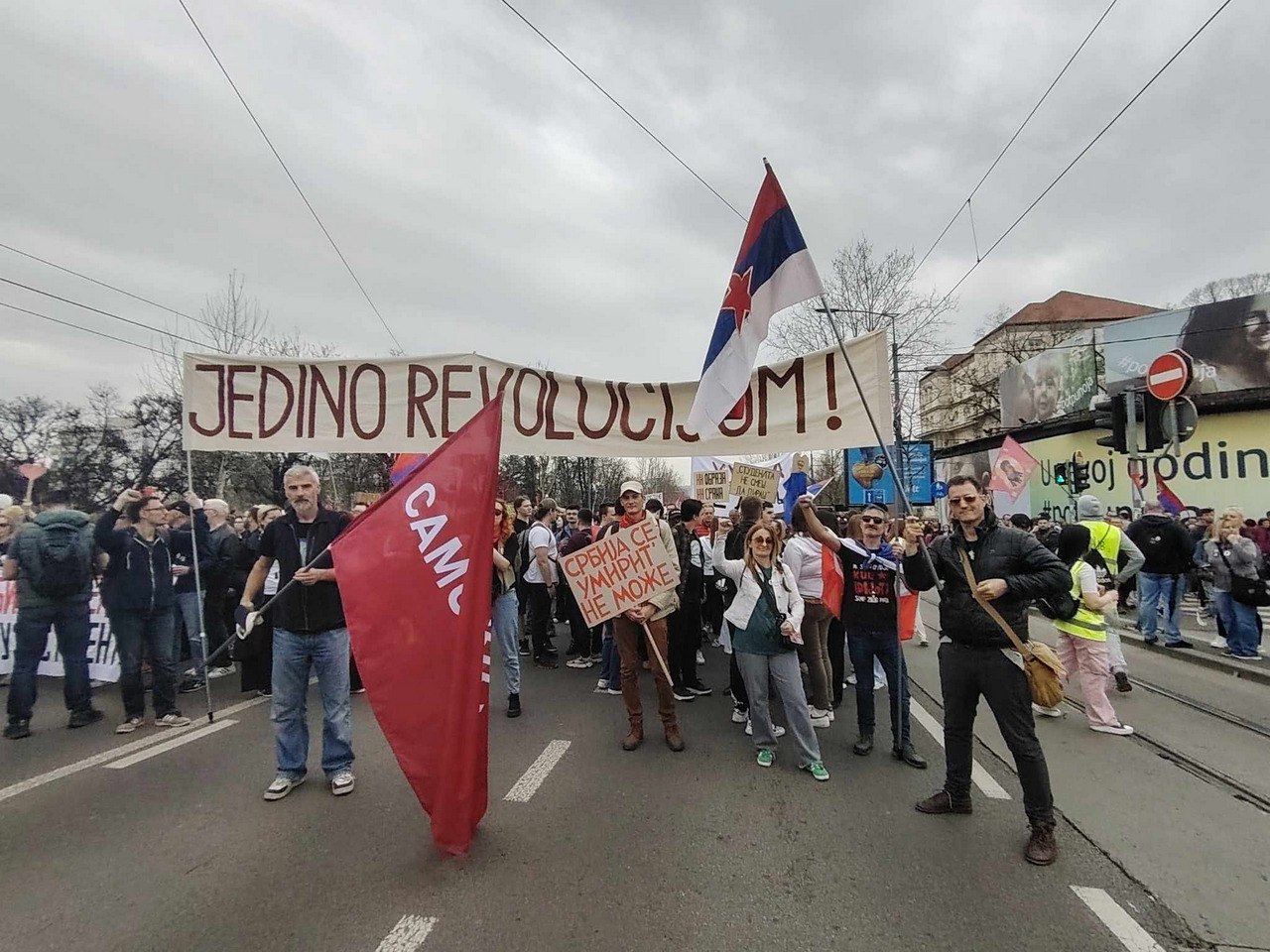
For more than ten months, a large part of society has been rebelling against the government, which has plunged into its first serious crisis in 13 years of existence, and which it has still not managed to overcome. You can read about our positions and participation so far in the movement and rallies in our publications, website and social networks. The role of Marxist-Leninists, among other things, is to interpret the phases in the development of the struggle and the movement, and the goal of this text is the same, because it is certain that the protest has entered a new phase of its development, because the process has been going on for a long time and there is no end in sight.
The government and the movement against the government are in inverse proportion and it often seems that if it were not for the counterproductive, lying and violent policies of the government that provoke people, the movement would simply wither away, as happened with earlier attempts by the liberal so-called opposition. The protest that has been going on since the beginning has been of a very broad social character, but whether all parts of the masses, most importantly the working class, have been affected remains to be seen. The tone and character of the demands are given by a part of the public sector that feels threatened by the predicted development of capitalism in Serbia. As we have previously stated, by far the greatest success of this protest is the politicization of the entire young generation that has so far not been involved in political life in any way. Another great achievement is the introduction of plenums and assemblies into the political life of Serbia, as well as a general aspiration towards the widest and most direct democracy. On the other hand, we warned that the nationwide character of the protest represents the minimum of its operability, and predicted inevitable ideological differentiation. It was to be expected that, if progress was desired in the political struggle, the movement itself would receive a clearer methodological, tactical and strategic direction. For its part, the authorities did not shy away not only from repression, but also from open terrorist acts, as was the case with the still undetermined weapon on March 15, 2025 at the largest political gathering in the history of Serbia. The word “war” can often be heard in regime propaganda, while regime propagandists and bots call for increased repression, more arrests and more police violence. Vučić himself, as is well known, has played the final whistle and announced countless times that he will explain to everyone how he defeated the coloured revolution, if it ever happens. We, adhering to the principle that we should act in the masses more often, more meaningfully and deeper, have worked to spread our ideas, kept our symbols alive and returned the flag of self-governance to fly proudly. We are glad to have seen that some of these things have been accepted by the masses, and that other flags have appeared modelled after ours. This tells us that there are still progressive and combative people who want to direct their energy towards socialism today, despite everything. However, we must also note that the main ideological struggle in the movement is between nationalists, with a certain dose of clericalism as well, and pro-Western liberals. First ones have their network built partly in the so-called security structures, and partly also the dissident-church milieu, while others are undoubted representatives of the interests of certain foreign powers. Let’s deal with that for a moment; many choose a position of neutrality due to the unclear situation and the famous question – who is leading the protests. Let’s just remember that until recently Serbia seemed like a dead sea, anesthetized, seemingly without rebellions, with a government that, thanks to an absolute majority in parliament and other institutions, is in a position to literally run wild, implementing its comprador and racketeering policy with great self-confidence.
The rebellions over the small hydroelectric power plant on Stara Planina and against Rio Tinto’s plans for lithium mining have shown that the political entity of Serbia is very much alive and ready for a serious struggle. Forces in the form of so-called services are always present in all rebellions, and one should not be naive and think that these are only foreign or only domestic services. They, of course, act, trying to direct the masses and their perception of reality to a certain side, essentially to take over and suppress. Therefore, there will be no pure protests, we must all be aware of this fact and act clearly against all attempts at instrumentalization and manipulation within the framework of the protests, which, logically, are constantly happening. The students demonstrated this very well and clearly throughout the first part of the uprising, and thus marginalized many attempts by professional pressure groups from the so-called civil sector to impose their agenda in conjunction with the media. Among other things, this is why this protest is so long-lasting and so deep. The government, for its part, uses precisely those forces that are endlessly compromised, such as the well-known organizations Stav, Sviće and similar ones, as the cornerstones of its meaningless propaganda against the protests.
However, as long as the protest exists, it will be exposed to the ferment of which force will prevail in it. At this moment, for a number of reasons, primarily financial and infrastructural, pro-Western forces are imposing themselves as those that set the decisive tone in the current organization of rallies and defining policies. Of course, they have their own media and a built-up infrastructure, which largely comes from the Republic of Serbia, because each party that has its own representatives receives an allowance of several thousand euros per member of parliament, and that is a special story about the functioning of this system that has yet to be told. There is no doubt that the protest entered a new phase with the end of the large rally held on June 28, which is the date of the Battle of Kosovo, and of course the date of Milošević’s large rally in 1989 on the ancient Christianized holiday of Vidovdan. At the very end of that rally on June 28, the students symbolically declared the transition from students’ to civic protest, repeating several times as a code or mantra: You have the green light. The beginning of the so-called civil protest is reflected in an attempt to accelerate the mass movement with some kind of coded calls on chat groups and various platforms, and in this attempt to accelerate it, the directly democratic character of the rebellion is reduced to an incomparably smaller extent, at first even completely, only to be remembered again when that acceleration entered the ebb phase.
At this moment, most of the protests are taking place according to the established pattern of reaction to some of the brutal moves of the police, who, despite the claims of the authorities, constantly behave brutally and exceed their authority. We especially condemn the actions of police officer Marko Kričko, the threats of rape and the revenge pornography launched by the propaganda and repressive apparatus of the authorities. The main demand of the protests is elections, and occasionally various forms of unacceptable ideas about a transitional government appear. The leaders of both sides are playing the strategy of tension, to the point of who will reach their breaking point first, but at the same time they sometimes give each other the wind in their sails with their wrong assessments of the balance of power and the current situation. The authorities, primarily through brutality, impudence and recklessness, and part of the opposition through an attempt at radicalization for the sake of radicalization according to the already seen pattern of attacks on empty buildings on a symbolic level and somewhat ritual blockades. We, for our part, want to keep the key topics in the spotlight: the fight against lithium mining, the fight against arms trade with Israel, the fight against imperialism and the involvement of the widest possible layer of workers in the fight for labour and social rights. We believe that the radicalism of the movement should primarily be reflected in the demands for essential social justice, and not for proven platitudes of constitutionality, or the non-existent freedom of the mainstream media that depend on capital. We also believe that for the fight to be more successful, it should be connected to as many similar processes as possible that exist in the Balkans and beyond. In this sense, we condemn the chauvinistic slogans that can be heard at the protests, in which members of the criminal state repressive apparatus are called by a derogatory term for Albanians. The same applies to the chants for Vučić with the same chauvinistic content. Tolerating chauvinism will not lead us to progress, no matter who is in power. It should be noted that in shouting these slogans there is no difference between the so-called pro-European citizenry and a part of the national-clerical group that opposes the regime and the official policy of the Church that supports it. For this protest to truly bring about change, it must stop suffering from outdated ideas such as the aforementioned national-chauvinism, and also those who constantly try to impose the EU as an arbiter on these issues, as if this same EU has not been involved up to its elbows in literally everything that has been happening in this country for decades. We reject and condemn the policy of servility towards Brussels and the orbiting powers in decline. More precisely, since the current government, like all the surrounding ones, is completely dependent on foreign powers, the approval of anyone else by the same people who support the current set does not actually bring any changes except personal ones. Therefore, the necessary overthrow of the existing government should be seen as an incidental, not even a minimal goal, because the real change that Balkan societies, all of them, and not just Serbia, yearn for can only come with the establishment of a completely new policy that will focus on production relations, the interests of the entire society, environmental protection and public interest, and not just the owners of capital, according to whose measure the daily life of all of us is tailored. We will continue to act, we will continue to raise the red flag high and proud everywhere, while the citizens await their elections and their appanage in parliament. While students write their program and compile a list, about which somethings leak from time to time, it is clear that at the moment the leading current in the movement is directed almost exclusively towards the public sector. We believe that it is in the general interest that the private sector, workers in foreign companies, workers who came or are coming from other countries must also be taken into account. First of all, we must be careful that the media war being waged between the two currents in the mainstream media does not turn into a smokescreen under which deals with companies will be concluded and lives, health and futures will be traded.
Against every capitalist government.
Against every chauvinism.
For socialism.

 Crvena akcija / Crvena inicijativa